
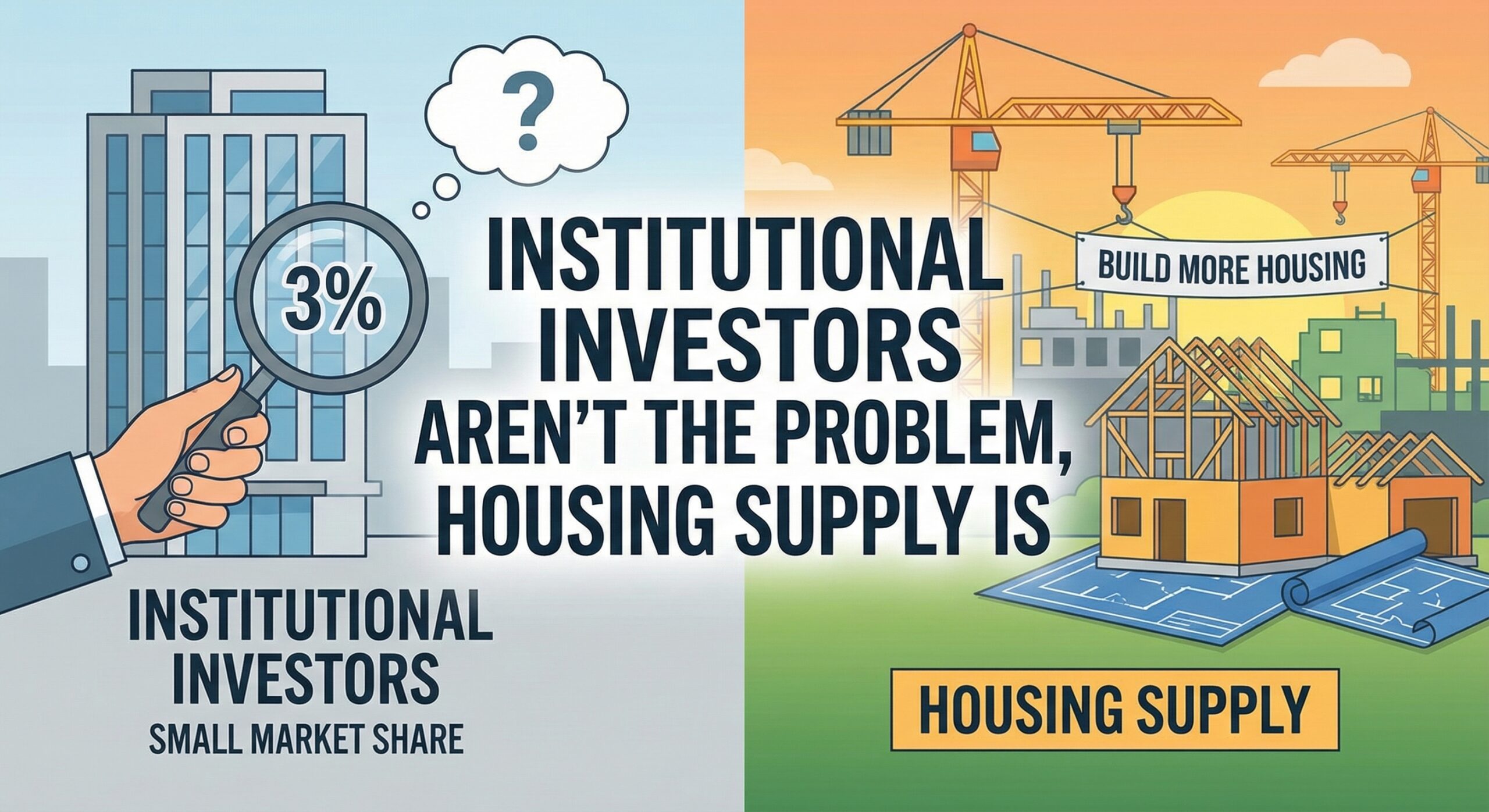
Institutional Investors Aren’t the Problem, Housing Supply Is
Every few years, housing policy becomes a political football, and lately, institutional investors are back in the spotlight. Proposals to ban large companies from buying single family homes have gained traction, and the rhetoric sounds good at first—big corporations shouldn’t be scooping up homes meant for families, right?
The problem is that narrative oversimplifies what’s really happening. And worse, it distracts us from the actual issue. We aren’t building enough homes. Not homes for owners, not homes for renters, and not at any scale that meets current or future demand.
The Numbers Don’t Support the Outrage
Institutional investors own roughly 3% of single family rental homes across the United States. That figure isn’t zero, but it’s far from anything resembling market control. In 2024, these investors accounted for only 0.3% of all home sales nationwide. The bulk of investor activity still comes from individuals or small-scale owners, not large corporations.
Even in cities like Atlanta where their presence is more visible, institutional buyers are far from dominant. Often, they purchase homes that need work or are in neighborhoods where rental options have historically been limited.
Rentals Remain in Short Supply
On the rental side, the picture isn’t much better. Between 2015 and 2020, the number of owner-occupied homes increased by nearly 10 percent. During the same time, the rental housing supply grew by less than 1 percent. That imbalance is driving up rental prices in many cities.
Removing institutional buyers from the market doesn’t magically produce more rental housing. It simply reduces one source of supply. Unless others step in to fill the gap, rental pressure will increase, not decrease.
What History Tells Us
After the 2008 housing crash, it was institutional buyers who stepped in to purchase distressed homes. They helped stabilize neighborhoods and kept properties from sitting vacant. That’s not just opinion—it’s a matter of record.
These companies brought capital, management systems, and scale. While there are legitimate criticisms about how some of them operate, particularly when it comes to rent increases or evictions, they didn’t create the housing affordability crisis. They responded to it.
Policy Without Production Hurts Renters
Banning institutions from buying homes doesn’t help people become homeowners, and it doesn’t build more rental inventory. It limits supply without solving the fundamental shortage of available housing.
If we want prices to come down and access to improve, the solution is straightforward. We need to build more. That means updating zoning laws, expediting permits, supporting new development, and backing builders who create both rental and for-sale housing.
A Window Opens for Smaller Investors
There is one group that could benefit from institutional pullback. Smaller investors, including first-time buyers and family-run portfolios, may find the market a bit more welcoming.
In recent years, many of them lost out to cash offers and fast closings from large firms. If that competition eases, even a little, it might open the door for new local landlords to purchase and hold properties for rental use.
Still, this opportunity only exists if there are homes to buy. And that brings us back to the root issue—housing production has not kept pace with demand.
Let’s Focus on the Right Problem
Institutional buyers didn’t cause this crisis. They filled a void that emerged after years of underbuilding. Blaming them may be politically convenient, but it won’t get us any closer to affordability.
If we want more people to own homes, and if we want more rental options for those who don’t, then the only real solution is to build more housing. Everything else is just noise.
Full disclosure in that I own a brokerage that represents buyers and sellers and we have an Atlanta Property Management Company as well. I don’t believe that anything I have said in this article is angled to support our business but rather represents an objective opinion about this topic…
Sources
- U.S. Government Accountability Office – Institutional Investors and Single-Family Rentals
- American Action Forum – Institutional Investors Aren’t Ruining the Housing Market
- Local Housing Solutions – The Role of Large Investors in Single-Family Rentals
- Kiplinger – Trump Proposes Ban on Institutional Single-Family Home Buyers
- Business Insider – Where Institutional Investors Own the Most Homes
- Axios – Trump’s Push to Ban Institutional Investors from Housing
- Federal Reserve Bank of St. Louis – Single-Family Rentals and Market Impact
- Reason – Institutional Investors and Housing Costs
- Joshua Coven – Job Market Paper on Institutional Ownership and Housing Markets
